Resume vs CV: what’s the difference?
In the US, a resume and a CV are two different documents. Elsewhere in the world, “CV” is simply the word for a resume. Using the wrong one can make an application look out of place, so here is how to tell them apart.
The short answer
- Resume: a short, targeted summary of your work experience, skills and education. Usually one page, two at most. Used for almost all US jobs.
- CV (curriculum vitae): a full record of your academic and professional history, including research, publications, teaching, grants and presentations. No length limit. Used in the US for academic, research, medical and some scientific roles.
How they differ
- Length: a resume is one or two pages. A CV grows with your career and can run to ten pages or more.
- Purpose: a resume is tailored to each job and leaves out what is not relevant. A CV is complete and changes little from one application to the next.
- Content: a resume focuses on achievements and skills. A CV adds publications, conferences, grants, teaching, research and professional memberships.
- Order: a resume usually leads with experience. An academic CV usually leads with education and research.
When to use a CV in the US
- Faculty, postdoc and research positions at universities.
- Graduate school, fellowship and grant applications.
- Medical residencies and physician roles.
- Some research and scientific roles in government and industry.
For everything else, including corporate, government, tech, healthcare support, retail and trades, use a resume. If a US job ad asks for a “CV”, check whether it is an academic role. If not, the employer usually means a resume.
What “CV” means outside the US
In the UK, Ireland, Europe, New Zealand and much of Asia and Africa, “CV” is the everyday word for the document Americans call a resume. A UK CV is usually two pages, longer than a US resume, but nothing like an academic CV. In Australia, “resume” and “CV” are used interchangeably. If you are applying abroad, follow local conventions for length, paper size (A4) and personal details.
Writing a CV for the UK? Read our UK guide
Converting between the two
Moving from academia to industry? Turn your CV into a resume by cutting it to one or two pages, leading with skills and results, picking only the publications that matter for the role, and describing research projects by what they achieved. Moving the other way, expand your resume with full lists of publications, presentations, teaching and grants.
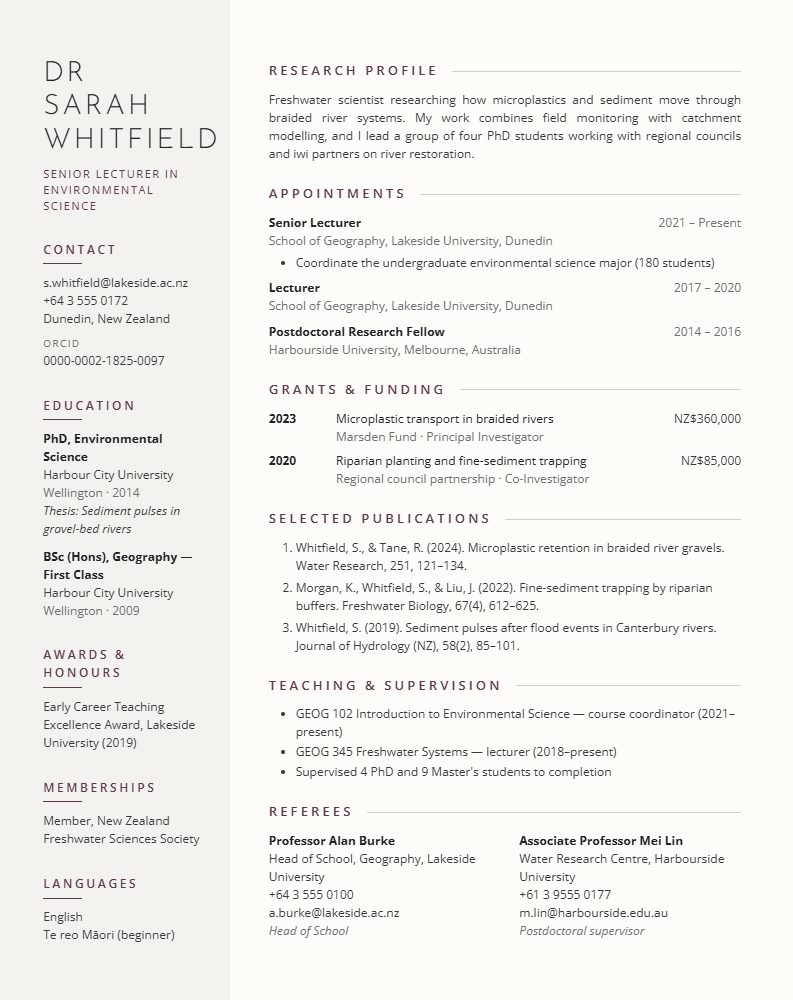
A modern academic CV for faculty, postdoc and fellowship applications.
Use this template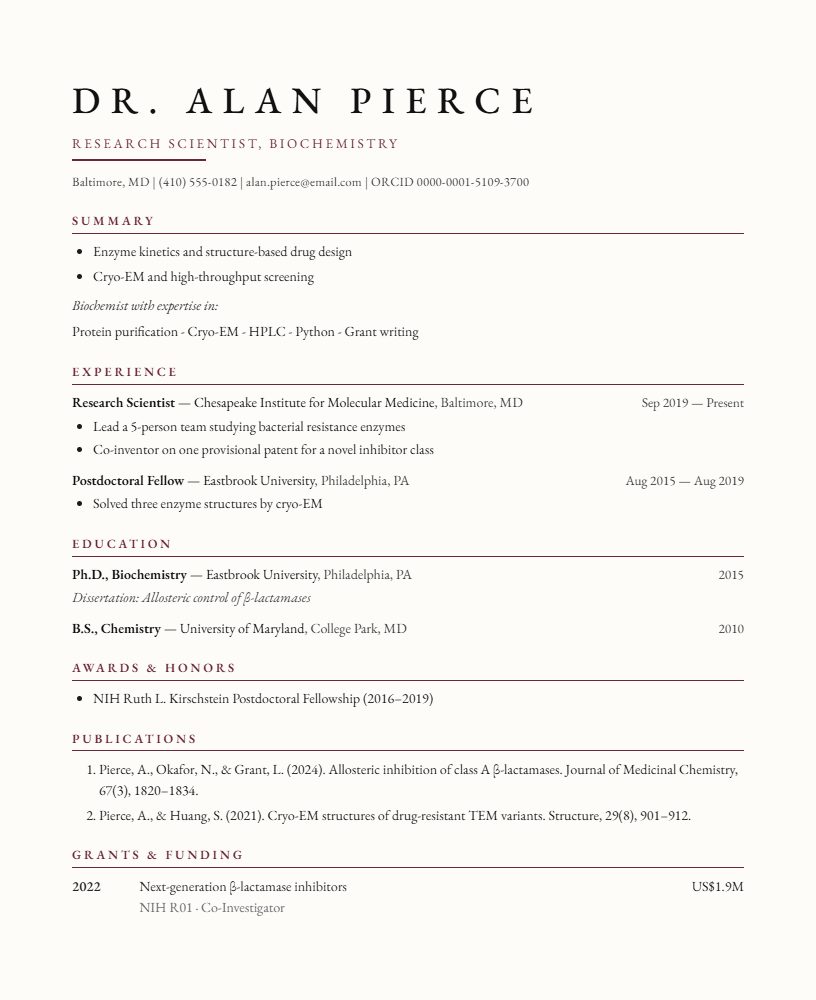
A compact CV for research scientists moving between academia and industry.
Use this templateFree to edit online. US$12 one-off to download, with no subscription.